

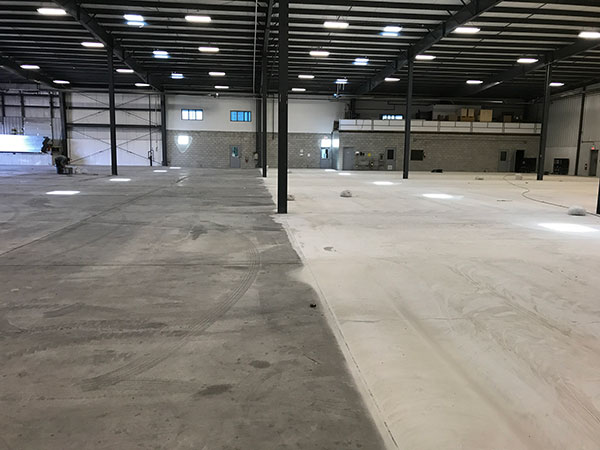
A warehouse slab is past repairing when the damage is structural rather than superficial — when cracks run full depth and move under load, when the sub-base beneath has failed and the slab is settling, or when the total repair area approaches the cost of replacement. Short of those three conditions, almost every warehouse floor that looks finished is actually repairable.
That last point is worth emphasising, because badly worn floors look far worse than they are. A slab with spalled joints throughout, surface scaling across the whole area, and cracks in every bay can look like a demolition job while remaining structurally sound underneath. Surface damage and joint damage are the two most visually alarming problems and the two most straightforward to fix.
The Three Conditions That Mean Replacement
1. Structural failure through the slab
Cracks that pass through the full thickness of the slab and move under load indicate the concrete is no longer acting as a structural element. Signs include cracks with vertical displacement between the two sides, cracking that reappears in the same location after previous repair, and slab sections that visibly deflect when a loaded forklift passes.
This is different from a surface crack, however wide. Depth and movement are what matter.
2. Sub-base failure
A concrete slab is only as stable as the material beneath it. Where the sub-base has washed out, consolidated unevenly, or was inadequately compacted at construction, the slab loses support and settles.
The symptoms are distinctive: slab sections at different heights, rocking or drumming underfoot or under equipment, and repairs that crack again in the same place because the underlying movement was never addressed.
Repairing the surface of a slab with a failed sub-base is spending money on a symptom. The cause is under the concrete.
3. Repair area approaching replacement cost
This is an economic threshold rather than a technical one. When enough of the floor needs deep repair, patching becomes more expensive than starting again — and leaves you with a patchwork surface rather than a uniform one.
There is no universal percentage that triggers this. It depends on repair depth, access, and what the finished floor needs to do. But when an assessment shows the majority of the floor requiring full-depth work, replacement deserves serious consideration.
What Looks Terminal but Usually Is Not
These conditions alarm facility managers and are routinely repairable:
- Spalled joints throughout the facility — the most common warehouse complaint, and entirely repairable however many joints are affected
- Widespread surface scaling — the wearing surface has failed, not the slab; grinding or an overlay rebuilds it
- Severe dusting — a surface-level problem addressed by grinding and densifying or by resurfacing
- Numerous dormant cracks — quantity does not indicate structural failure if they are not moving
- Heavy oil contamination — unpleasant, but mechanical removal reaches clean concrete
- Decades of accumulated wear — age alone means very little; a 40-year-old slab in a well-drained building can be in better condition than a 10-year-old slab over a poor sub-base
How a Proper Assessment Works
Distinguishing repairable from terminal requires more than a visual inspection.
Crack monitoring. Monitors fitted across representative cracks and read over several weeks establish whether movement is ongoing. This is the single most useful piece of evidence, and it cannot be gathered in a single visit — which is why any contractor declaring your slab beyond repair on a first walkthrough is guessing.
Sounding. Tapping the slab reveals delamination and voids beneath. A hollow response indicates the concrete has separated from what is underneath.
Core sampling. Where structural questions remain, cores show actual slab thickness, condition through the depth, and the state of the sub-base.
Level survey. Mapping the floor’s elevation identifies settlement patterns and reveals whether movement follows a shape consistent with sub-base failure.
Depth of deterioration. Establishing where sound concrete begins determines whether grinding is sufficient or an overlay is needed.
The Cost Comparison Nobody Runs Properly
Replacement is usually compared to repair on price alone, which understates it substantially. Full replacement means demolition, removal and disposal of the existing slab, sub-base preparation, new concrete, and a cure period before the floor carries load.
That last item is the one that gets underestimated. New concrete needs time before it accepts full loading, and it needs additional time before it can be coated or polished. For an operating warehouse, that is weeks during which the area produces nothing.
Restoration is typically a fraction of that cost and can usually be phased around operations. We cover how that works in restoring a warehouse floor without shutting down.
Partial Replacement Is Often the Answer
The choice is rarely all or nothing. Where structural failure is confined to specific bays — often near loading docks, where impact loads and moisture concentrate — those sections can be removed and replaced while the remainder of the floor is restored.
This is frequently the most economical outcome, and it is the option a contractor quoting full replacement has no incentive to raise.
Getting an Honest Answer
There is a real conflict of interest here. A contractor who only does replacements will find reasons to replace. A contractor who only does repairs will attempt repairs that should not be attempted.
What you want is an assessment that gathers actual evidence — crack movement over time, sounding, cores where warranted — and then tells you plainly which category your slab falls into, including when that answer is replacement.
Armour Guard has assessed and restored industrial concrete floors across Toronto and the GTA for more than 30 years. We have saved floors other contractors condemned, and we have recommended replacement where a slab genuinely could not be saved.
If you are weighing repair against replacement, our warehouse concrete restoration service starts with establishing which one your floor actually needs.
Contact our Toronto team to arrange an assessment.