

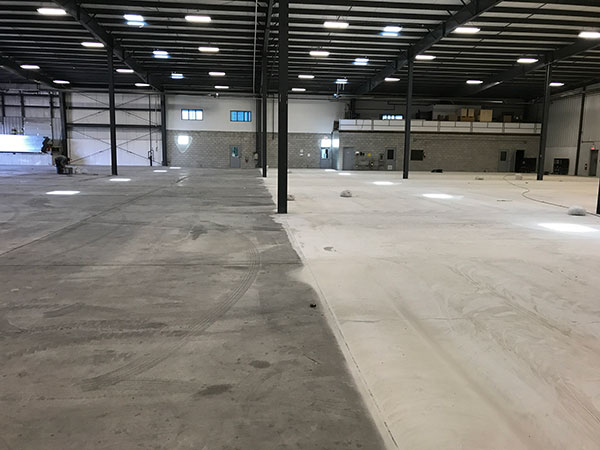
Warehouses across the GTA depend on their floors more than almost any other building system. Forklift traffic runs constantly, pallet racks impose heavy point loads, and thousands of square feet must stay smooth, safe, and functional through years of demanding use. When it comes time to install or upgrade warehouse flooring, two options consistently rise to the top: commercial epoxy flooring and polished concrete. Both deliver the durability warehouses require, but they suit different priorities. For most Toronto warehouses, polished concrete offers the best combination of durability and low maintenance, while epoxy provides superior chemical resistance and customization when your operation needs those specific benefits.
The right choice depends on how your warehouse actually operates. A distribution centre with constant forklift traffic has different needs than a facility storing chemicals or a warehouse that doubles as a light manufacturing space. Understanding how these two flooring systems perform in real warehouse conditions helps you invest in flooring that supports your operations for decades rather than requiring frequent repairs and replacements.
This guide compares epoxy and polished concrete for warehouse applications throughout Toronto, examining the factors that matter most to facility managers and property owners making this important decision.
Understanding Warehouse Flooring Demands
Before comparing systems, it helps to understand what makes warehouse flooring so demanding. These environments combine stressors that quickly reveal the weaknesses of inadequate flooring.
Forklift and equipment traffic is relentless in active warehouses. Loaded forklifts, pallet jacks, and material handling equipment travel the same routes hundreds of times daily. The wheels create abrasion and rolling loads that grind down inferior flooring. Warehouse floors must withstand this constant traffic without wearing through, cracking, or developing ruts.
Point loads from racking systems concentrate enormous weight onto small areas. Loaded pallet racks impose tremendous pressure on the floor at each support point. The flooring and underlying concrete must handle these concentrated loads without cracking or failing over time.
Impact resistance matters because warehouses involve dropped items, pallet handling, and general rough use. Products fall, equipment bumps into surfaces, and materials get dragged across floors. Quality warehouse flooring resists this impact without chipping or gouging.
Dust control is a genuine concern in warehouse environments. Bare or poorly finished concrete generates dust that contaminates products, damages equipment, and creates unhealthy working conditions. Both epoxy and polished concrete address this problem by creating sealed, dust-free surfaces.
Toronto’s seasonal conditions add another factor. Warehouses that aren’t fully climate controlled experience temperature swings and moisture from snow and salt tracked in during winter months. The flooring must perform reliably despite these seasonal challenges.

Polished Concrete for Warehouses
Polished concrete has become one of the most popular warehouse flooring solutions throughout the GTA, and for good reason. The system transforms the existing concrete slab into a durable, attractive surface without adding a separate coating.
The primary advantage of polished concrete in warehouses is exceptional abrasion resistance. Because the floor is the densified concrete substrate itself, there’s no coating to wear through. Forklift traffic that would eventually grind down epoxy coatings barely affects properly polished concrete. This makes polished concrete ideal for high-traffic distribution centres and warehouses where equipment runs constantly.
Durability translates directly to value in warehouse settings. Polished concrete withstands the heavy point loads from racking, resists impact from dropped materials, and maintains its surface through years of demanding use. Many Toronto warehouses with polished concrete floors see service lives measured in decades with minimal intervention.
Maintenance requirements are minimal, which matters enormously for large warehouse floors. Polished concrete needs only regular dust mopping and occasional damp cleaning. There’s no waxing, stripping, or recoating required. For facility managers overseeing hundreds of thousands of square feet, this minimal maintenance translates to substantial labor and cost savings over the floor’s life.
The light reflectivity of polished concrete improves warehouse working conditions. The reflective surface enhances both natural and artificial lighting, brightening the facility and potentially reducing lighting costs. Better visibility also supports safety in busy warehouse environments.
Cost effectiveness makes polished concrete particularly attractive for large warehouse floors. While the initial investment is real, the combination of durability, minimal maintenance, and long service life delivers excellent value over time. Working with an experienced polished concrete contractor ensures the floor achieves the durability and finish your warehouse requires.
The main limitation is that polished concrete requires reasonably sound concrete to begin with. Severely damaged or heavily contaminated warehouse slabs may need extensive repair before polishing, which affects project feasibility and cost.
Commercial Epoxy Flooring for Warehouses
Commercial epoxy flooring offers warehouses different advantages that make it the better choice in specific situations. Rather than refining the existing concrete, epoxy applies a protective coating that seals and transforms the floor.
The complete moisture and chemical barrier that epoxy creates is its defining advantage. The seamless coating completely seals the concrete, preventing penetration by liquids, oils, and chemicals. Warehouses that store chemicals, handle automotive fluids, or face moisture concerns benefit significantly from this protective barrier. Polished concrete, despite densification, remains more porous than epoxy.
Customization possibilities give epoxy an edge for warehouses needing specific visual features. Safety line marking, color-coded zones, and traffic patterns can be permanently integrated into the epoxy system. This built-in organization improves both safety and operational efficiency. Warehouses with complex traffic flows or safety zone requirements find this capability valuable.
The ability to address damaged concrete makes epoxy practical for warehouses with compromised slabs. Epoxy mortar systems fill cracks, level uneven surfaces, and create new floor surfaces over damaged concrete. For older Toronto warehouses with worn or damaged floors, epoxy systems can rebuild the surface where polishing might not be feasible.
Slip resistance can be enhanced through additives incorporated into the epoxy topcoat. Warehouses with wet areas, wash-down zones, or spaces where spills occur benefit from customized traction that improves worker safety.
Impact and chemical resistance in heavy-duty epoxy systems handle demanding warehouse conditions. High-build and epoxy mortar systems withstand forklift traffic, dropped materials, and chemical exposure while protecting the concrete substrate beneath.
The trade off is that epoxy coatings eventually wear in high-traffic areas and require topcoat renewal or recoating over time. This maintenance represents a cost and operational consideration that polished concrete largely avoids.
Direct Comparison for Warehouse Applications
Understanding how these systems compare directly across the factors that matter most helps clarify which suits your warehouse.
For abrasion resistance and high-traffic durability, polished concrete generally holds the advantage. The densified concrete surface withstands constant forklift traffic without the wear that eventually affects coatings. Warehouses with intense equipment traffic often favor polished concrete for this reason.
For chemical resistance and moisture protection, commercial epoxy flooring is superior. The impermeable barrier protects against spills and penetration that polished concrete cannot fully prevent. Warehouses handling chemicals, fluids, or facing moisture issues benefit from epoxy’s complete seal.
For maintenance and long-term cost, polished concrete typically wins. The minimal maintenance and absence of recoating requirements deliver lower lifetime costs for most warehouse applications. Epoxy’s eventual topcoat renewal adds cost over the floor’s life.
For customization and safety marking, epoxy offers more flexibility. Integrated line striping, color coding, and zone marking support warehouse organization and safety in ways polished concrete cannot easily match.
For handling damaged concrete, epoxy provides more options. Epoxy mortar systems rebuild compromised surfaces, while polished concrete requires sound substrate to achieve good results.
For initial cost, the systems are often comparable, though specific project conditions affect pricing. Concrete condition, warehouse size, and system specifications all influence the final investment for either option.
Making the Right Choice for Your Toronto Warehouse
Selecting between epoxy and polished concrete requires evaluating your warehouse’s specific operations and priorities.
Choose polished concrete when your warehouse prioritizes maximum durability, minimal maintenance, and long-term value. High-traffic distribution centres, storage warehouses, and facilities with sound concrete slabs benefit from polished concrete’s abrasion resistance and low maintenance. If your operation doesn’t involve significant chemical exposure and your concrete is in reasonable condition, polished concrete often delivers the best overall value.
Choose commercial epoxy flooring when your warehouse handles chemicals, needs moisture protection, requires extensive safety marking, or has damaged concrete requiring repair. Facilities storing chemicals, warehouses with wash-down areas, and operations needing color-coded zones or complex traffic marking benefit from epoxy’s protective barrier and customization.
Consider your concrete condition carefully. Sound concrete makes polished concrete viable and cost effective. Damaged or contaminated slabs may require the repair capabilities that epoxy systems provide.
Think about your operational timeline and priorities. Long-term facility ownership favors polished concrete’s lifetime value. Specific performance requirements around chemicals, moisture, or safety marking may point toward epoxy regardless of other factors.
Professional assessment provides the clearest guidance. An experienced contractor evaluates your concrete, understands your operations, and recommends the system that truly serves your warehouse rather than applying a generic solution.
Frequently Asked Questions About Warehouse Flooring
Which is more cost effective for large warehouses in Toronto?
For most large warehouses, polished concrete delivers better long-term cost effectiveness. While initial costs are comparable between the systems, polished concrete’s minimal maintenance and absence of recoating requirements reduce lifetime expenses significantly. Over a 15 to 20 year period, the savings on maintenance, topcoat renewal, and business disruption make polished concrete more economical for typical warehouse applications. However, if your warehouse handles chemicals or has damaged concrete, commercial epoxy flooring may provide better value by preventing costly substrate damage or rebuilding compromised surfaces. The most cost-effective choice depends on your specific conditions, which is why professional assessment helps clarify the best investment for your facility.
Can warehouse flooring handle heavy forklift traffic?
Both polished concrete and quality epoxy systems handle heavy forklift traffic when properly installed, though polished concrete generally offers superior abrasion resistance for the highest traffic environments. Because polished concrete is the densified concrete substrate itself, there’s no coating to wear through under constant forklift use. Heavy-duty epoxy systems including high-build and epoxy mortar formulations also withstand significant forklift traffic while providing additional benefits like chemical resistance. The key factor for either system is proper installation with thorough surface preparation. A warehouse floor that fails under forklift traffic almost always traces back to inadequate preparation rather than the flooring system itself.
How long does warehouse flooring installation take?
Installation timelines depend on warehouse size, concrete condition, and the system selected. Polished concrete for a typical warehouse takes several days to over a week depending on square footage and desired finish. Commercial epoxy flooring generally requires three to five days including preparation, application, and curing, though larger facilities take longer. Both systems can often be installed in phases, allowing portions of the warehouse to remain operational while work proceeds in other areas. Fast-cure epoxy options reduce downtime for operations that cannot afford extended closures. Experienced contractors coordinate scheduling around your operational needs to minimize disruption to warehouse activities.
Do warehouse floors need to handle Toronto winters?
Warehouse floors in Toronto must handle seasonal challenges including temperature fluctuations and moisture from snow and salt tracked in during winter. Both polished concrete and quality epoxy systems perform well in these conditions when properly installed. Polished concrete, being the concrete substrate itself, isn’t affected by temperature changes beyond normal concrete behavior, and its sealed surface resists salt and moisture penetration. Epoxy systems are formulated to accommodate thermal cycling and create complete moisture barriers. For warehouses without full climate control, both systems provide reliable year-round performance. Proper installation with appropriate products ensures your warehouse floor withstands Toronto’s seasonal extremes regardless of which system you choose.
Choose the Right Warehouse Flooring for Your GTA Facility
Your warehouse floor is fundamental infrastructure that affects operations, safety, and maintenance costs every single day. Whether you choose polished concrete or commercial epoxy flooring, the right system supports efficient operations and protects your investment for years. The decision comes down to your specific priorities: maximum durability and minimal maintenance point toward polished concrete, while chemical resistance, moisture protection, and customization favor epoxy.
The most important factor in either case is professional installation with thorough surface preparation. Even the best flooring system fails without proper preparation, while quality installation ensures your warehouse floor performs reliably through years of demanding use.
With over 30 years of experience serving Toronto and the GTA, Armour Guard specializes in both polished concrete and commercial epoxy flooring for warehouses and distribution facilities. As an experienced polished concrete contractor and epoxy flooring specialist, we understand the demands warehouse environments place on flooring systems. We provide honest recommendations based on your specific operations rather than pushing one solution regardless of fit.
Contact Armour Guard today to discuss your warehouse flooring project. We’ll evaluate your concrete, understand your operational requirements, and recommend the optimal solution whether that’s polished concrete, commercial epoxy flooring, or a specialized system suited to your facility. Invest in warehouse flooring built to perform through years of demanding GTA operations.