

How to Fix Spalled Joints in a Warehouse Floor

Spalled joints are fixed by saw-cutting the broken edges back to sound concrete, rebuilding the profile with a repair mortar, and filling the joint with a semi-rigid filler that supports the edges under wheel load. The filler is the part that determines whether the repair lasts. Soft sealants let the edges flex and break again […]
Can Polished Concrete Handle Forklift Traffic?
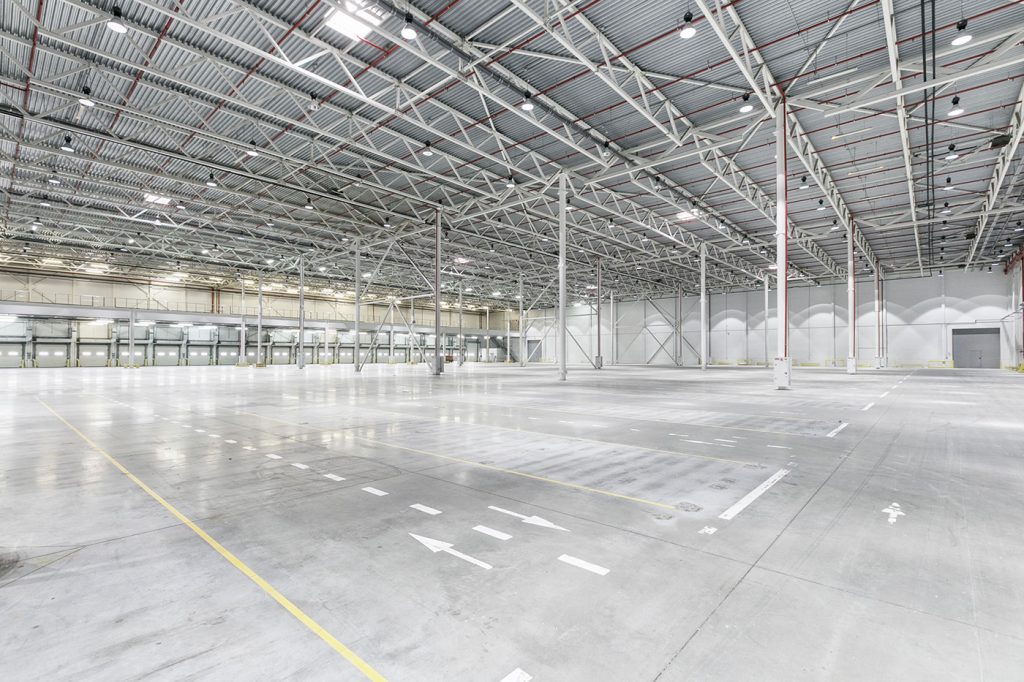
Yes. Polished concrete handles forklift traffic well, and in many warehouses it outperforms a coated floor. The reason is straightforward: there is no coating to delaminate. Polishing refines and hardens the slab itself, so the wearing surface is the concrete. A forklift wheel cannot lift a polished floor because there is nothing on top of […]
Why Concrete Dust Is a Problem in Warehouses

Concrete dust in a warehouse is not just untidy. It is the surface of your floor breaking down and becoming airborne, and it settles into inventory, packaging, bearings, and lungs. The dust comes from a process called dusting, where the top layer of a concrete slab loses cohesion and powders under traffic. Every forklift pass […]
Which Warehouse Floor Costs Less Over 10 Years?

Over a ten-year horizon, polished concrete is usually the cheaper warehouse floor — not because it costs less to install, but because it has no recoating cycle. A resinous coating typically needs a new wear layer at some point in that window, and each recoat carries both material cost and downtime. Polished concrete is maintained […]
What Flooring Suits Cold Storage Warehouses?

Cold storage and freezer warehouses need flooring that tolerates thermal cycling, not just low temperature. Urethane cement is the usual answer, because it expands and contracts at a rate close to concrete itself and stays bonded where an epoxy system would eventually debond. Standard epoxy becomes brittle at freezer temperatures and struggles with the repeated […]
What Does ANSI/ESD S20.20 Require for Flooring?

ANSI/ESD S20.20 sets two flooring requirements, and most specifications only mention the first. The floor must measure less than 1.0 × 10⁹ ohms resistance when tested to ANSI/ESD STM7.1, and the footwear-and-flooring system must generate less than 100 volts of body voltage during a defined walking test to ANSI/ESD STM97.2. That second requirement is the […]
How Do You Maintain an ESD Floor?

Maintaining an ESD floor comes down to one rule above all others: never apply anything to the surface that was not specified for it. Ordinary floor finishes, waxes, and polishes are electrical insulators. Applied to a static dissipative floor, they sit on top of the conductive path and block it — and the floor keeps […]
ESD Flooring for Electronics Manufacturing in Toronto

Electronics manufacturing facilities in Toronto typically need static dissipative flooring in the 1.0 × 10⁶ to 1.0 × 10⁹ ohm range, grounded to a copper grid and verified for body voltage generation under 100 volts. That specification comes from ANSI/ESD S20.20, which most electronics manufacturers work to either by customer requirement or by certification. What […]
Can You Apply Epoxy Over Cracked Concrete?
Yes, but not directly over the crack. Epoxy is a rigid coating that follows whatever is underneath it, so a crack left untreated will telegraph straight through the finished floor — usually within the first year, sometimes within weeks. Cracks have to be routed out, filled with a structural repair material, and, most importantly, understood […]
Why Urethane Cement Handles Thermal Shock Better Than Epoxy

Urethane cement handles thermal shock better than epoxy for one fundamental reason: its coefficient of thermal expansion is close to that of concrete, while epoxy’s is significantly higher. When a floor is heated or cooled rapidly, urethane cement expands and contracts at roughly the same rate as the slab beneath it. Epoxy does not — […]