

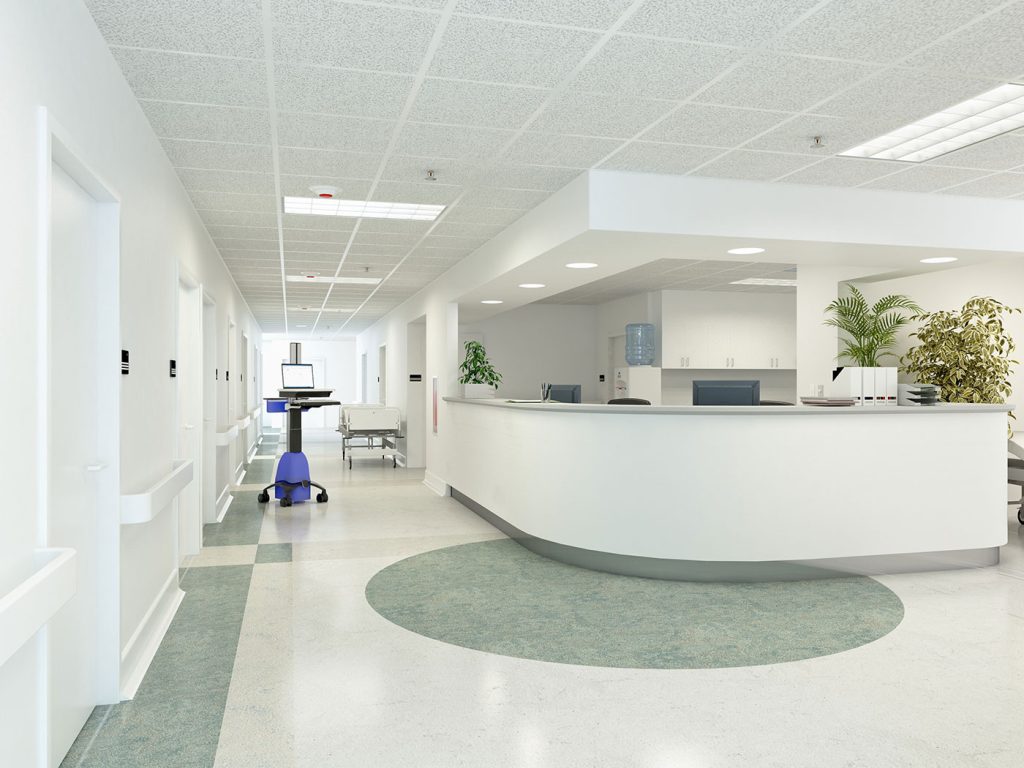
Antimicrobial flooring contains an additive — most commonly silver ions, though zinc and copper compounds are also used — that disrupts the growth of bacteria, mould, and fungi on the floor surface. It is not a disinfectant and it does not replace cleaning. What it does is suppress microbial colonisation between cleaning cycles, particularly in the seams, joints, and micro-texture where organisms would otherwise establish themselves.
It is required, or effectively expected, in healthcare facilities, food processing environments, pharmaceutical manufacturing, laboratories, and increasingly in veterinary and long-term care settings. In most other buildings it is optional and often unnecessary.
The distinction between marketing and mechanism matters here, so this article covers how the technology actually works, where it earns its cost, and where a seamless non-antimicrobial floor performs just as well.
How Antimicrobial Flooring Works
The additive is dispersed through the resin during manufacture rather than applied as a surface treatment. That distinction is important: because the agent is distributed throughout the material, the antimicrobial property is not worn away as the surface abrades over years of traffic.
Silver-ion technology is the most widely used. Silver ions interfere with microbial cell function, disrupting the ability of bacteria and fungi to reproduce on the treated surface. The effect is continuous and passive — it operates around the clock without any action from staff.
What it does not do
This is where a lot of marketing overreaches, so it is worth being direct:
- It does not sterilise the floor
- It does not kill organisms on contact the way a disinfectant does
- It does not reduce your cleaning obligations
- It does not act on viruses in the way it acts on bacteria and fungi
- It does not compensate for a floor with cracks and joints
An antimicrobial additive in a floor full of seams is a marketing feature. The seamlessness is doing the heavy lifting; the additive is a secondary layer of protection.
Where Antimicrobial Flooring Is Genuinely Required
Healthcare facilities
Hospitals, clinics, surgical suites, and long-term care facilities face infection control requirements that make every surface part of the strategy. Floors in patient care areas, operating theatres, and isolation rooms are specified as seamless and cleanable first, with antimicrobial properties as an additional control.
Our approach to healthcare flooring in Toronto treats the floor as part of the facility’s infection control programme rather than as a finish.
Food and beverage processing
Wet processing environments combine organic residue, moisture, and warmth — ideal conditions for microbial growth. Antimicrobial systems add a control layer between sanitation cycles, particularly around drains and cove transitions.
Pharmaceutical and laboratory environments
Cleanrooms and pharmaceutical production areas operate under contamination control protocols where bioburden on any surface is monitored. See pharmaceutical flooring in Toronto for these environments.
Veterinary and animal facilities
Kennels, veterinary clinics, and animal research facilities deal with biological soil at volume, with cleaning regimes that are frequent and aggressive.
Where It Is Usually Unnecessary
Being straightforward about this: in a warehouse, a retail store, an office, a mechanical room, or a residential garage, an antimicrobial additive rarely justifies its cost. These environments do not have the moisture, organic load, or contamination sensitivity that make the technology worthwhile.
The money is better spent on getting the substrate preparation right, or on a more durable topcoat that will actually extend the floor’s life. A seamless, properly installed, easily cleaned floor delivers the overwhelming majority of the hygiene benefit on its own.
Seamlessness Matters More Than the Additive
If there is one point worth taking from this article, it is this. The single largest hygiene improvement available in a flooring system is eliminating the places where microbes can hide.
Grout lines, tile joints, cracks, and the gap where floor meets wall are all harbourage points. Cleaning cannot reliably reach into them. A monolithic resinous floor with integral coving removes them entirely, which is why seamless systems became standard in hygiene-critical environments long before antimicrobial additives were available.
The correct sequence when specifying is: seamless first, correct chemical and thermal resistance second, antimicrobial additive third. A system that gets the first two right and skips the third outperforms one that reverses the order.
Specifying an Antimicrobial System
Questions worth asking a contractor:
- Is the additive dispersed through the material or applied to the surface? Surface treatments wear off.
- What organisms has it been tested against? Efficacy varies by organism type.
- Does it hold up under your specific sanitation chemicals? Aggressive cleaning regimes affect some systems.
- How does it integrate with coving and drains? The details are where hygiene is won or lost.
For facilities where antimicrobial performance is part of the requirement, antimicrobial flooring installation in Toronto covers the systems available and the environments they suit.
Getting Advice Rather Than a Sales Pitch
Antimicrobial flooring is a legitimate technology that is frequently oversold. Armour Guard has specified flooring for Toronto healthcare, food processing, and pharmaceutical facilities for more than 30 years, and we will tell you when the additive is worth specifying and when your money is better spent elsewhere in the system.
Contact our Toronto team to discuss what your facility actually needs.