

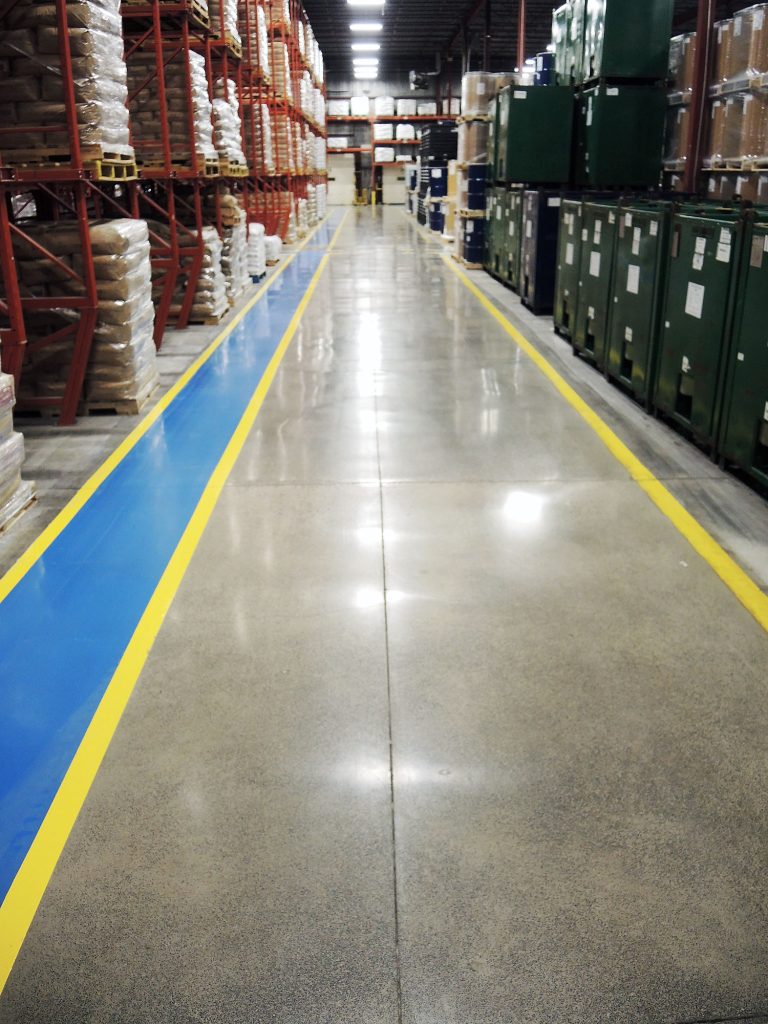
Ontario does not prescribe line colours or widths for warehouse floor markings. This surprises people who expect a regulation they can point to, but the Industrial Establishments Regulation — R.R.O. 1990, Reg. 851 under the Occupational Health and Safety Act — is largely performance-based. It requires that aisles and floors be kept free of obstructions and hazards, and that workplaces be organised so workers are not endangered. It does not tell you to paint a yellow line 50mm wide.
What that means in practice: you are obliged to achieve a safe result, and floor marking is one of the recognised ways to do it. The colour conventions most Ontario warehouses follow come from industry standards and long-established practice rather than from statute.
This article covers what the regulation actually asks for, the marking conventions that have become de facto expectations, and how to build a scheme that holds up.
What Reg. 851 Requires
The provisions most relevant to floor marking concern housekeeping and traffic:
- Aisles, floors, and walkways must be kept free of obstructions and hazards
- Workplaces must be arranged so material handling equipment and pedestrians can operate without endangering workers
- Adequate lighting must be provided
- Open edges and floor openings must be guarded
Alongside these sits the OHSA general duty to take every precaution reasonable in the circumstances. That obligation is broader than any numbered rule, and it is where floor marking genuinely lives: if separating forklift routes from pedestrian walkways would reduce a real hazard in your facility, doing so is a reasonable precaution whether or not a specific section names it.
A cluttered or undefined aisle in a facility with active forklift traffic is a hazard an inspector can act on. The absence of a prescriptive marking rule is not the absence of an obligation.
The Colour Conventions
These are drawn from widely used safety colour standards and common industrial practice. They are conventions rather than Ontario legal requirements, but consistency matters more than any individual choice — a scheme workers can read instantly is the point.
- Yellow — aisles, traffic lanes, and work cell boundaries. The most common general-purpose marking.
- White — equipment, workstations, carts, and racking not otherwise colour-coded.
- Blue, green, or black — materials and components: raw stock, work in progress, finished goods.
- Orange — material awaiting inspection or hold status.
- Red — defects, scrap, rework, and red tag areas.
- Red and white stripes — areas that must be kept clear for safety or compliance, such as electrical panel access and fire equipment.
- Black and yellow stripes — physical or health hazards.
- Black and white stripes — areas kept clear for operational reasons without a specific safety hazard.
Keep-clear zones
Some clearances are driven by other codes rather than by Reg. 851 — electrical panel working space under the Ontario Electrical Safety Code, and access to fire extinguishers, hose cabinets, and exits under the Fire Code. Marking these on the floor is how facilities keep them clear in practice, and it is one of the highest-value applications of line marking there is.
Building a Marking Scheme That Works
Separate pedestrians from equipment. Forklift and pedestrian interaction is among the most serious hazards in any warehouse. Defined pedestrian walkways, ideally routed away from main traffic lanes, address it directly.
Make aisles wide enough for actual use. Marking an aisle narrower than your equipment needs guarantees it will be ignored. Measure your widest load and add clearance.
Mark intersections and blind corners. Stop lines, hatching, and directional arrows at points where sightlines are poor.
Be consistent throughout. A colour that means one thing in shipping and another in production defeats the purpose.
Document it. A written legend, included in worker orientation, turns a painted line into a communicated procedure.
Painted Lines or Tape?
Tape installs quickly with no cure time, is easy to reconfigure, and suits facilities whose layouts change. It lifts under forklift traffic, particularly at corners where wheels turn across the edge, and needs regular replacement.
Painted or coated lines last far longer under heavy traffic, cannot peel at the edges, and can be integrated into the floor coating itself so the marking sits within the system rather than on top of it. They require downtime to install and are harder to change.
For a settled layout with heavy equipment traffic, integrated marking is the durable answer. Our safety line marking and warehouse floor markings in Toronto covers these installations.
Marking Only Works on a Sound Floor
Lines applied to a deteriorating slab fail with the slab. Where concrete is spalling, dusting, or contaminated with oil, marking will not adhere and will not stay legible.
Facilities addressing floor condition and marking together generally get a better result than those treating them as separate projects. Warehouse facility flooring in Toronto covers coating systems with marking integrated into the specification.
Reviewing What You Have
Worth walking your facility and asking:
- Are pedestrian routes clearly distinct from equipment routes?
- Are lines still legible, or worn to the point of being decorative?
- Does the marking reflect your current layout or a previous one?
- Are electrical panels, fire equipment, and exits kept clear?
- Do workers know what each colour means?
Faded or obsolete marking is arguably worse than none — it signals that the scheme is not maintained.
Getting It Done
Armour Guard has installed floor marking in Toronto warehouses and industrial facilities for more than 30 years, both as standalone work and integrated into new flooring systems.
Contact our Toronto team to discuss a marking scheme for your facility.
This article is general information about floor marking practice, not legal or health and safety advice. For obligations specific to your workplace, consult a qualified health and safety professional or the Ontario Ministry of Labour, Immigration, Training and Skills Development.
