

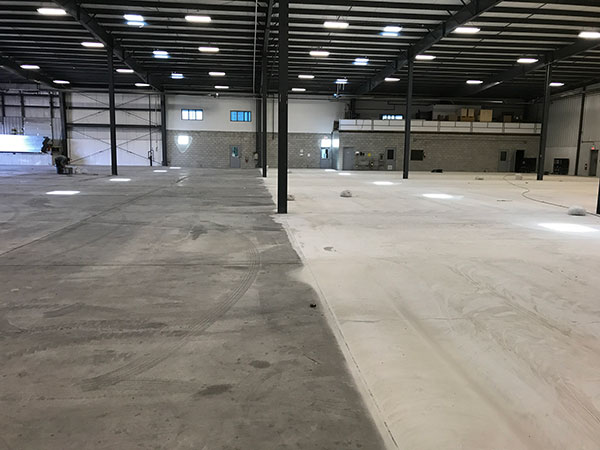
Spalled joints are fixed by saw-cutting the broken edges back to sound concrete, rebuilding the profile with a repair mortar, and filling the joint with a semi-rigid filler that supports the edges under wheel load. The filler is the part that determines whether the repair lasts. Soft sealants let the edges flex and break again within a season; rigid materials crack as the slab moves.
Joint spalling is the most common complaint we hear about warehouse floors in Toronto, and it is also the most misunderstood. The joint is not failing because the concrete is weak. It is failing because nothing is supporting the edge when a loaded forklift wheel drops across the gap.
Why Joints Spall in the First Place
Control joints are deliberate. When concrete cures it shrinks, and a slab with no planned weak points cracks wherever it chooses. Saw-cut joints tell the slab where to crack so the cracking is straight, predictable, and controlled.
The problem comes afterward. A joint is a vertical gap running through the wearing surface, and it creates two unsupported concrete edges facing each other. When a hard forklift wheel crosses, the load transfers abruptly from one side to the other. The edge takes an impact rather than a smooth roll.
One pass does nothing. A busy aisle sees thousands of passes a week, and the edge fatigues, micro-fractures, and eventually breaks away. Once it does, the gap is wider, the wheel drops harder, and the deterioration accelerates on both sides.
What makes it worse
- Hard wheels — polyurethane and steel forklift wheels transmit far more shock to a joint edge than cushioned tyres
- Empty or missing filler — a joint that was never filled, or whose filler has shrunk or been torn out, offers no edge support at all
- The wrong filler — soft, flexible sealant compresses under load instead of supporting the edge
- Debris in the joint — grit packed into the gap prevents proper filling later and can wedge the joint open
- Toronto freeze-thaw — water sitting in an open joint near a loading bay freezes, expands, and pries the edges apart
The Repair, Step by Step
1. Saw-cut back to sound concrete
The damaged edges are cut back on both sides to reach concrete that is intact. This produces a clean rectangular channel with vertical faces rather than a ragged, crumbling edge.
This step is where corners get cut, and it shows. Repair mortar placed against fractured concrete bonds to material that is already failing, and the repair breaks away with it.
2. Clean and prepare the channel
All debris, dust, and old filler are removed. Vacuum extraction rather than blowing, since blowing simply redistributes dust into the channel you are about to fill.
3. Rebuild the edges
The channel is filled with a repair mortar chosen for the traffic it will carry. In an operating warehouse this is usually a rapid-set material that accepts forklift traffic within hours.
4. Re-establish the joint
The joint itself has to remain a joint. The slab still needs somewhere to move, so the repair is saw-cut through at the original joint location rather than being bridged solid. Bridging a control joint forces the slab to crack somewhere else, usually a few centimetres away and in a place you did not choose.
5. Fill with semi-rigid filler
The joint is filled full-depth with a semi-rigid filler — typically a polyurea or epoxy-based product. Full-depth matters: a shallow bead of filler over a void has nothing beneath it and collapses under the first wheel.
The filler is then shaved flush with the floor so the surface is continuous and wheels roll across rather than into it.
Why Semi-Rigid Filler, Specifically
This is the technical decision that separates a lasting repair from a recurring one, and it comes down to a trade-off.
A joint filler has two jobs that pull against each other. It must be hard enough to physically support the concrete edges against wheel impact, and it must be flexible enough to accommodate slab movement from thermal change and ongoing shrinkage.
Soft elastomeric sealants — the kind used for expansion joints and exterior work — handle movement well and provide no edge support whatsoever. Wheels compress them and hammer the edge underneath. These belong in expansion joints, not in control joints carrying traffic.
Rigid epoxies support the edge well and cannot accommodate movement. They crack, debond, and leave the joint unprotected again.
Semi-rigid fillers sit deliberately between the two. They are firm enough to carry wheel loads across the joint while retaining enough give to tolerate the slab’s movement.
If a contractor proposes a flexible sealant for a control joint in a trafficked aisle, that is the moment to ask why.
Fixing Joints Before They Spall
Joint armouring is worth raising because it is far cheaper than repair. Where joints are still sound but the traffic is heavy, filling them properly with semi-rigid material now prevents the damage cycle from starting.
In new construction, steel-armoured joint systems are cast into the slab to protect the edges permanently. In an existing warehouse, correct filling achieves most of the same benefit at a fraction of the cost.
Walking your aisles and identifying joints that are empty, cracked, or filled with the wrong material is one of the highest-return maintenance tasks available in a warehouse.
Doing It Without Stopping Work
Joint repair suits phasing better than almost any other floor work. Each joint is a narrow strip closed for a few hours, and traffic routes around it through adjacent aisles.
With rapid-set materials, a crew working overnight can complete a substantial run of joints and hand the aisle back at shift start. We cover the sequencing in restoring a warehouse floor without shutting down.
Where Joint Repair Fits
Joint spalling rarely arrives alone. A floor with badly spalled joints usually has surface wear and cracking as well, and addressing everything in one mobilisation costs less than three separate visits. Our broader guide to repairing a damaged warehouse concrete floor covers the other repair types.
Armour Guard has repaired and armoured joints in warehouses across Toronto and the GTA for more than 30 years. If your aisles are getting rougher and your operators are complaining, our warehouse concrete restoration service starts with an assessment of what your joints actually need.
Contact our Toronto team to arrange a walkthrough.